English
 Français
 Pусский
 Español
 Português
 ไทย
 العربية
 िन्दी
 Indonesia

حلول مخصصة لصيانة المسارات

Meta Title: Warranty Void Risk | Aftermarket Hi-Rail Retrofit vs Factory Integrated Rail Excavator Meta Description: Many railway contractors choose aftermarket hi-rail wheel kits to convert standard excavators. Learn how these unapproved retrofits trigger warranty exclusion, hidden mechanical risks and the value of factory-built hi-rail excavators.
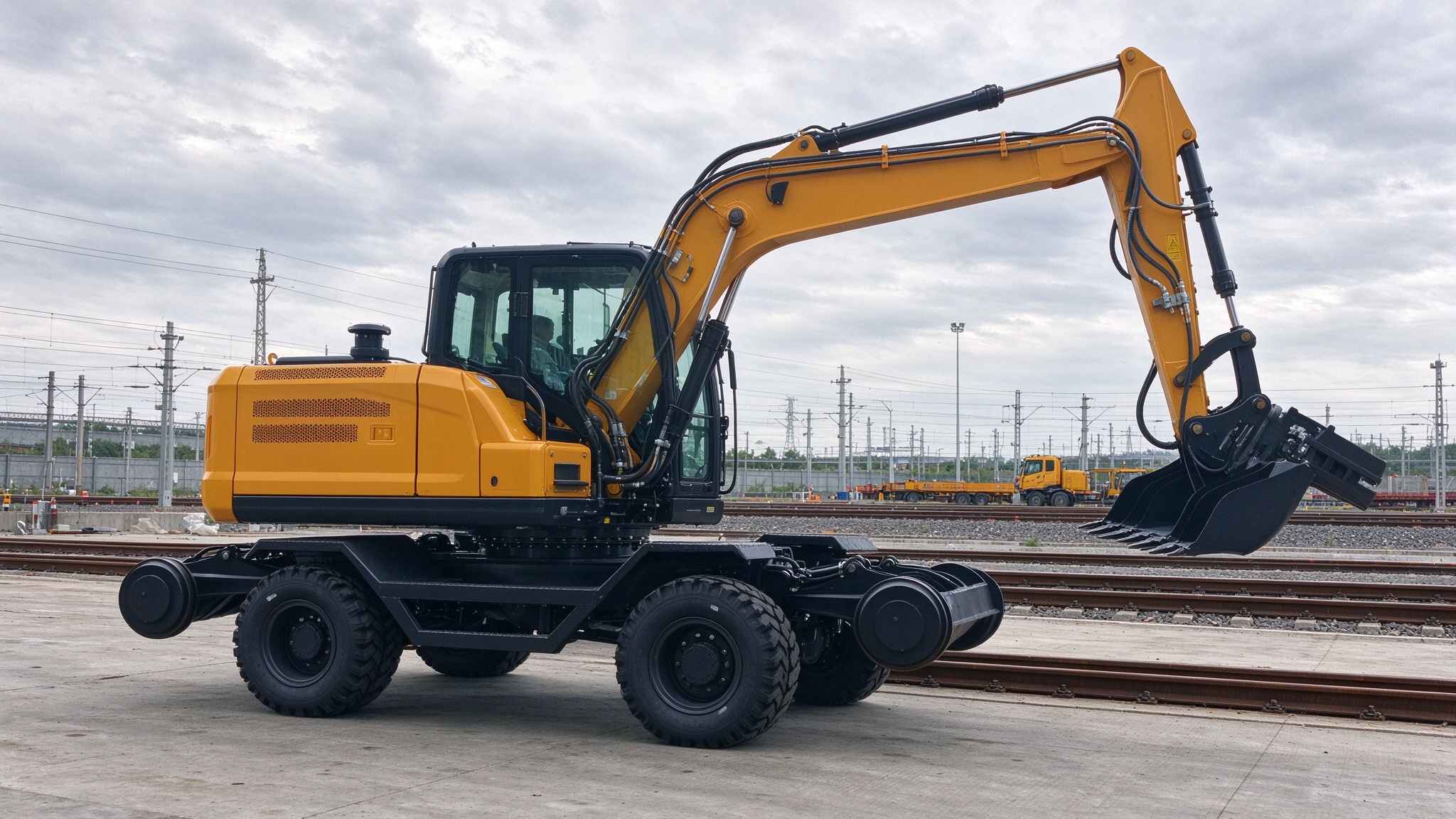
For railway maintenance contractors, fleet managers and rental companies working on track rehabilitation, sleeper replacement and ballast regulation, the appeal of aftermarket hi-rail conversion kits is straightforward. A standard excavator already sits on the fleet roster; the business owns the machine, has operators trained on it, and understands its service schedule. Adding a bolt-on hi-rail wheel set seems like a fast, low-cost workaround to unlock on-track operation without writing a large cheque for a dedicated rail machine.
On paper, the math makes sense. The conversion can be completed in a local workshop within a few days. The kit supplier provides mounting brackets, hydraulic drive wheels, control valves and basic operating instructions. For short-term track jobs or scattered maintenance tasks, this option has become extremely common across many railway markets. But there is a contractual and mechanical risk that is routinely overlooked until a major breakdown occurs: unapproved hi-rail retrofits can create grounds for the original equipment manufacturer (OEM) to deny warranty claims, and in many cases, the denial extends far beyond the rail wheel hardware itself.
This article explains exactly what “warranty void” means in heavy equipment contracts, breaks down the engineering reasons OEMs reject liability for retrofitted machines, compares the risk profile against factory integrated hi-rail excavators, and gives practical steps you can take to protect your warranty coverage if you are evaluating rail conversion options. It is not a blanket argument that all retrofits are unsafe. It is a clear breakdown of the commercial and technical tradeoffs that every equipment buyer should review before welding brackets, tapping hydraulic circuits and driving the machine onto active rail lines.
A common misunderstanding among contractors is that if you add a third-party hi-rail kit, only the rail wheels themselves lose warranty protection. That interpretation is incorrect under most OEM warranty terms. The core principle in heavy equipment warranty agreements is causation: if the OEM can demonstrate that the modification introduced load, vibration, hydraulic interference or stability changes that contributed to a component failure, they have the right to reject the warranty claim for that failure.
Depending on the brand, regional legislation and the wording of the warranty document, the scope of exclusion can be broad. For example, a cracked chassis frame, premature swing bearing wear, unexplained hydraulic pump failure, overheating engine or damaged travel motor can all be traced back to the hi-rail conversion. Even faults that appear unrelated at first glance can be linked during the OEM’s technical inspection. The burden of proof often falls on the equipment owner to prove that the failure had no connection to the retrofit, which is difficult and expensive.
It is important to note the difference between legal protection and OEM policy. In markets such as the United States, the Magnuson-Moss Warranty Act prevents manufacturers from voiding an entire warranty solely because an aftermarket part is fitted. The OEM must prove the modification caused the defect. While this rule limits blanket warranty cancellation, it does not eliminate the risk. For hi-rail conversions, the mechanical changes are substantial and invasive, making it much easier for the OEM’s engineering team to establish a causal link. In many European, Southeast Asian and Oceania markets, construction machinery warranty clauses are written with broader exclusion language for unapproved structural and hydraulic modifications.
When a warranty claim is denied, the full cost of parts, labour, field service and downtime falls on the contractor. For railway projects, downtime carries extra penalties: track access windows are tightly scheduled, possession periods are limited, and delays can trigger liquidated damages against the main contractor. The upfront savings on a retrofit kit can quickly disappear into emergency repair bills and project penalties.
Every production excavator is validated through a rigorous design process. The chassis strength, weight distribution, counterweight balance, hydraulic flow rates, pressure relief settings, cooling capacity, lifting chart and stability envelope are all calculated and tested for off-road digging, loading and travel. An aftermarket hi-rail kit is a universal add-on, designed to fit a range of machine models, rather than co-developed for one specific excavator platform. The mismatches introduced by this generic design create hidden stress points that OEMs cannot validate.
First, the added mass of rail wheels, support brackets, hydraulic manifolds and auxiliary valves changes the centre of gravity. On-track operation subjects the machine to a unique mix of loads: longitudinal braking forces along the rail, lateral sway when crossing switches, dynamic impact at rail joints and uneven support from ballast. These loads are not present in standard off-road operation. The original chassis, boom and swing structure are not fatigue-rated for this repeated loading cycle. Welded brackets often create stress concentrations on the main frame, which over hundreds of working hours lead to frame cracking or accelerated fatigue.
Second, hydraulic integration is a frequent failure point. Most retrofitted hi-rail kits tap into the existing auxiliary hydraulic circuit of the base machine. The kit supplier may adjust flow, pressure or sequence without full knowledge of the OEM’s hydraulic control logic. This can create backpressure spikes, interfere with priority valves, disrupt load sensing systems and cause premature wear on pumps, motors and seals. Even if the installation is completed by a skilled hydraulic technician, the OEM’s validation testing never included this modified circuit configuration, so they will not accept liability for downstream hydraulic damage.
Third, stability and tipping risk changes the operating envelope. The OEM’s certified load charts and stability calculations assume the machine operates on soil, gravel or hard ground. When running on rails, the track footprint is narrow, and the allowable lifting and slewing limits shift dramatically. Many retrofit kits do not come with recertified stability documentation tailored to the host excavator. If the operator works to the original machine lifting chart while on track, the risk of overturning rises, and any resulting damage will be excluded from warranty.
OEMs cannot audit the steel grade of third-party brackets, verify welding procedure qualifications, inspect bolt torque records, or validate finite element stress reports for every field installation. Since they cannot control the quality of the modification, they will not accept responsibility for its long-term consequences.
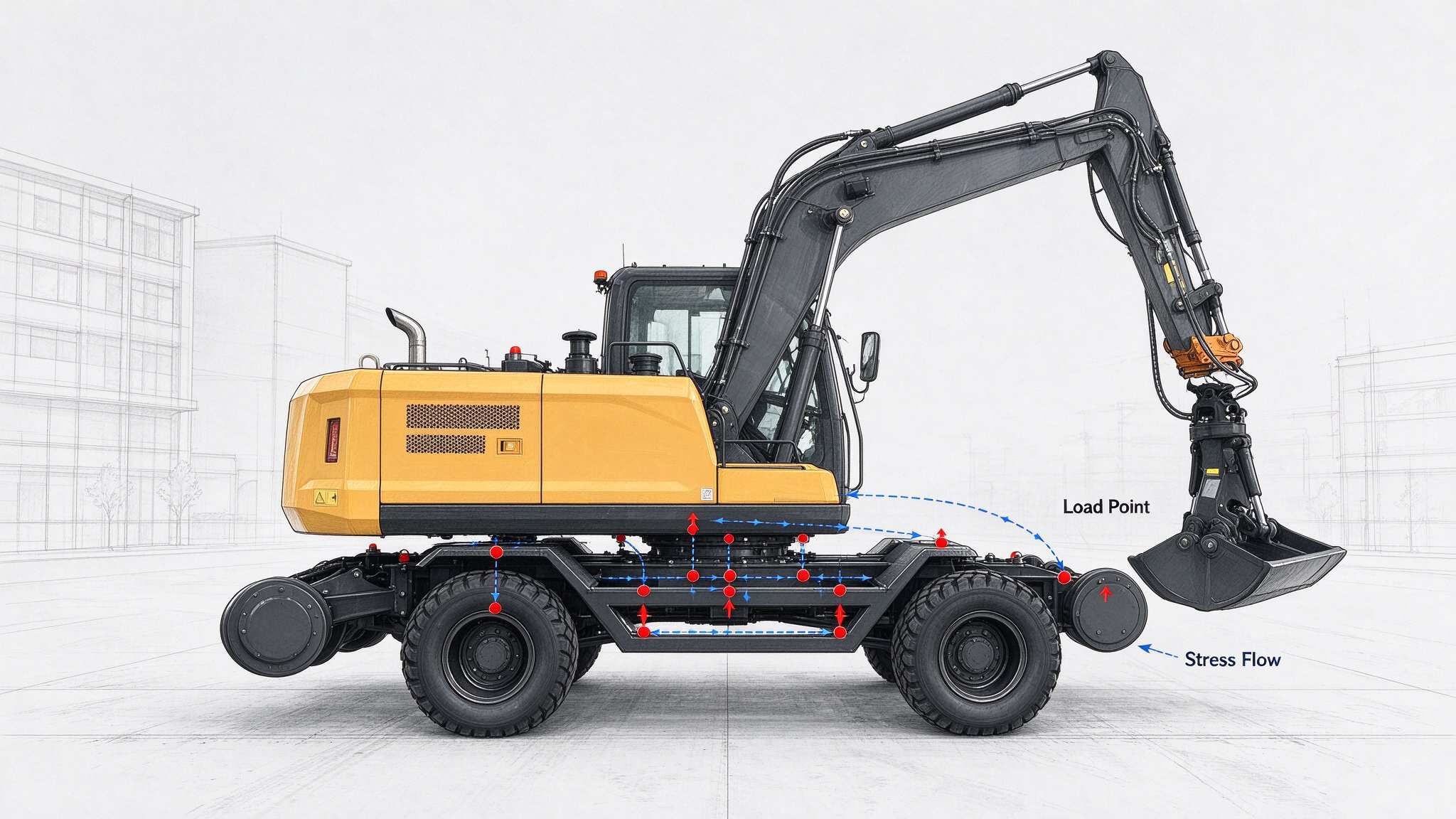
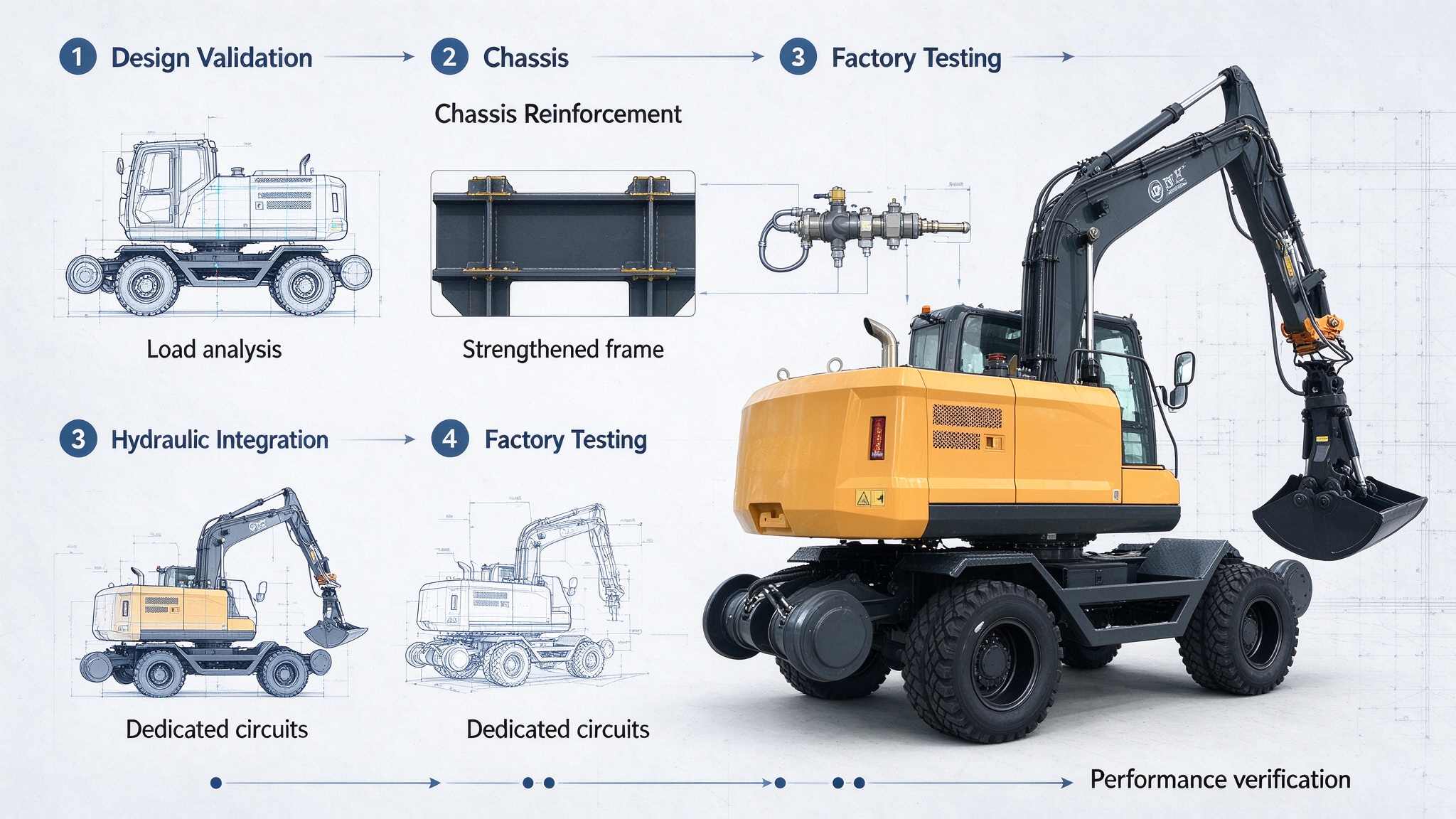
A factory integrated hi-rail excavator removes this warranty conflict because the rail travel system is part of the original machine design. The chassis is reinforced in the correct locations, counterweight mass and position are adjusted to maintain safe centre of gravity, hydraulic circuits are dedicated and programmed for rail travel, and stability testing is completed for on-track operating conditions before the machine leaves the factory.
All modifications are documented, reviewed by the OEM engineering team, and included in the machine’s official specification. The hi-rail wheel assembly, control valves, safety interlocks and on-track operating limits are covered under the same factory warranty as the engine, hydraulics, swing bearing and chassis. When a fault occurs during track maintenance work, the warranty process follows the standard procedure. There is no separate technical dispute over whether a third-party kit caused the failure.
Factory-built rail excavators also carry additional compliance benefits. They can be certified to local railway safety standards, CE requirements, and rolling stock access rules. For railway asset owners, this traceability is valuable during audits, tender reviews and safety file checks. Retrofit kits may carry their own component certification, but that certification does not automatically extend to the modified base excavator.
The obvious tradeoff is purchase cost. Factory integrated rail machines have a higher upfront price than a standard excavator plus retrofit kit. Delivery lead times are also longer, as the machine is built or modified in a controlled factory environment rather than fitted in a local workshop. For contractors running continuous track maintenance programmes, long-term framework contracts, or working for strict railway infrastructure owners, the warranty continuity and safety compliance often outweigh the higher initial investment.
| Item | Aftermarket Hi-Rail Retrofit | Factory Integrated Rail Excavator |
| Upfront capital cost | Lower initial spend | Higher purchase price |
| Warranty coverage | High risk of OEM warranty denial for related failures | Full machine warranty remains valid, including rail system |
| Engineering matching | Generic kit, not model-specific engineered | Custom load calculation, reinforced chassis and matched hydraulics |
| Stability & certification | Stability charts rarely recertified; railway compliance dependent on installer | Full stability validation, ready for railway audit and CE documentation |
| Installation timeline | Fast workshop fit-out, rapid deployment | Longer production and factory modification lead time |
| Resale value | Resale value impacted by modification history and warranty risk | Clear, documented rail configuration, easier to resell to railway-focused buyers |
| Downtime risk | Higher, due to warranty disputes and unvalidated design | Lower, with standard OEM service and spare parts support |
If you are considering hi-rail conversion, the first step is to pull out your original OEM warranty document and read the modification exclusion clauses carefully. Many major construction equipment brands explicitly list unapproved structural and hydraulic modifications as warranty exclusions.
If you still plan to proceed with a retrofit, obtain written confirmation from the base machine manufacturer that the hi-rail conversion is approved. Verbal confirmation from a dealer or sales representative is not enforceable when a claim is submitted. You should also keep complete records: installation drawings, welding reports, bolt torque logs, hydraulic test data and stability assessment documents. Even with these records, the OEM still retains the right to assess causation if a failure occurs.
Understand the limits of the kit supplier’s warranty. The third-party converter will typically provide a limited warranty covering their rail wheels, brackets and valves. This warranty does not cover the host excavator engine, pump, frame or swing bearing. If the retrofit damages the base machine, the kit supplier’s liability is often capped or excluded.
For long-duration track maintenance projects, recurring line work, or jobs for government railway authorities, factory integrated hi-rail excavators deliver predictable risk. You avoid the grey area of modification liability, keep your OEM warranty intact, and receive a machine designed specifically for the unique dynamic loads of rail operation.
EN:Yes. The risk is triggered by the physical modification itself, not how often you drive on rail. Once unapproved brackets are welded and hydraulic circuits are tapped, the OEM has grounds to investigate any related failure. Infrequent use does not reset the engineering fatigue or hydraulic change introduced by the conversion.
EN:No. A third-party installer cannot override the OEM’s warranty contract. Their guarantee only applies to their own kit and installation work. They cannot bind the excavator manufacturer to accept future claims.
EN:Not universally. For short, small-scale track assignments with tight budget limits and a clear acceptance of risk, a retrofit may still be a practical choice. The decision should be made after calculating the cost of lost warranty, potential downtime and repair exposure, not just the initial invoice price.
If you are sourcing factory-engineered hi-rail excavators for sleeper replacement, ballast maintenance and track renewal projects, contact our team for full specification and compliance support. Email: winny@fjjgjx.com | Tel:+86 18805957336 Quanzhou JINGGONG Machinery Equipment Co., Ltd.